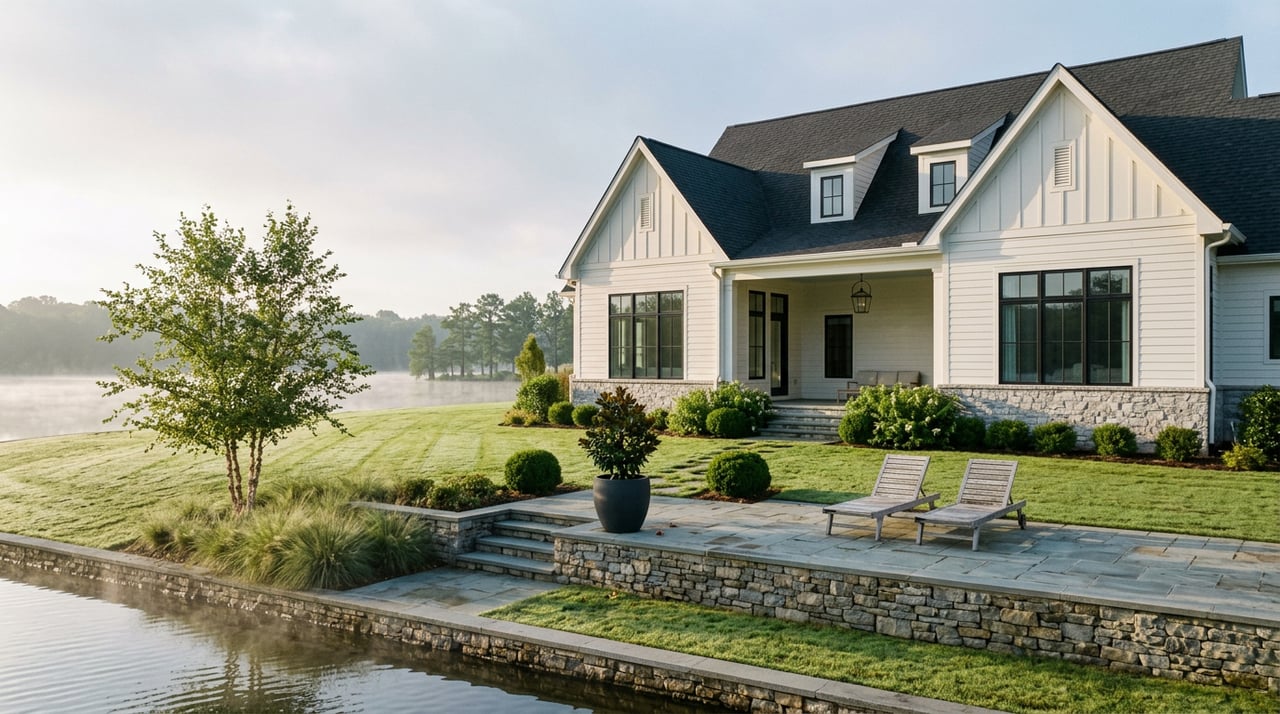
Every waterfront listing on Lake Norman shows the dock like it's a kitchen island. Same gallery, same lighting, same implicit promise: this comes with the house. It doesn't. The dock sits on land Duke Energy owns, under a permit that belongs to the current owner, and that permit has its own approval clock that rarely lines up with the one on your contract.
I've watched buyers discover this the hard way, usually somewhere around day ten of a fourteen-day due diligence period, when the question "is the dock actually theirs to sell me?" turns out to have a longer answer than anyone expected.
Your Property Line Stops at 760
Lake Norman is a hydroelectric reservoir. Duke Energy built it, operates it under a federal license from the Federal Energy Regulatory Commission, and controls everything at or below what's called full pond, the 760-foot elevation line that marks the water's surface when the lake is completely full. Everything below that line, including the dock, the boat lift, the seawall, and any riprap along the bank, sits on land Duke Energy controls, not the homeowner.
That means when a listing shows a dock, what you're actually looking at is a structure built with Duke's permission on Duke's property, attached to a house you're about to own. The distinction sounds technical until you realize it changes who has the final say over whether that dock can stay, get modified, or get rebuilt after a storm.
The Permit Doesn't Follow the Deed
Here's the part that catches people off guard. A Lake Norman dock permit is issued to a specific person, not to the land. When a house sells, the permit doesn't automatically transfer with the deed the way a driveway or a fence does. The new owner has to apply to transfer it, and Duke Energy's Lake Services team will only hand over compliance records that are filed under the current permit holder's name.
If the seller never transferred the permit from a previous owner, or never had one issued at all, there's no record to check. The buyer inherits the same blank spot the seller had, except now it's their closing on the line instead of someone else's.
Grandfathered docks add another layer. Some structures on the lake were built under older rules and are allowed to stay as they are, but that protection isn't permanent. Modify the dock, expand it, add a roof, or change its footprint, and the grandfathered status can disappear, triggering a full review under current standards instead of the looser rules it was built under.
None of this shows up in a listing photo. It shows up in a permit file that may or may not exist.
The Clock That Doesn't Match the Calendar
North Carolina buyers are used to due diligence working a certain way. You pay a due diligence fee directly to the seller, and that fee is non-refundable the moment you sign, win or lose. In exchange, you get an unrestricted window, often somewhere between fourteen and thirty days on Lake Norman, to walk away for any reason, no justification required, and get your earnest money back.
That system was built for a house. It assumes a home inspector, a pest inspector, and maybe a well or septic specialist can turn around meaningful answers inside two or three weeks. On the water, one more inspection joins that list, and it doesn't move at the same speed.
| What you're verifying | Typical timeline |
|---|---|
| Home inspection | A few days to schedule and complete |
| Septic or well inspection | Days to about a week |
| Standard Duke Energy dock permit review | Roughly four to twelve weeks |
| Permit transfer into buyer's name | Additional time on top of review, especially if records are incomplete |
A buyer with a standard fourteen-day due diligence period can get a full home inspection done twice over in the time it takes Duke Energy to process a routine dock review. If anything about the dock needs verifying beyond "does a permit exist," that verification is very unlikely to finish before the non-refundable clock runs out.
This is the mismatch that matters. The due diligence system is designed to protect buyers from surprises discovered during a defined window. On waterfront property, the one asset most likely to hide a real problem is also the one least likely to get fully checked inside that window.
What Changed on July 1
Duke Energy just tightened this further. Effective July 1, 2026, the utility stopped reviewing private dock applications for lots where no home has been built yet. The rule applies across every Duke Energy lake, not just Lake Norman.
The practical effect is narrow on its face. It closes a path some buyers used to reserve dock rights on vacant waterfront lots before construction started. But it also confirms something worth sitting with: Duke Energy treats the dock permit as tied to occupied, developed property, not as a standing right that comes with owning waterfront land. If the utility is willing to pull permitting eligibility from vacant lots outright, it's a reminder that permits on existing homes are administrative approvals Duke can shape, not fixed features that transfer the way a deeded easement would.
A Practical Order of Operations
If you're looking at a Lake Norman waterfront property, the sequence matters more than the checklist itself.
- Ask for the seller's dock permit and any transfer paperwork before you write the offer, not after. If the seller can't produce it, that's information you want while you still have negotiating room on price and terms.
- If a permit exists but was never transferred into the current seller's name, expect the transfer process to add real time, and build that into your due diligence period rather than assuming it clears at the same pace as a home inspection.
- If you plan to add a lift, cover a slip, or expand from one slip to two, ask about a preliminary feasibility check with Duke Energy before you're financially committed. A neighbor having a covered slip doesn't mean yours will be approved the same way.
- Get the dock and shoreline looked at by someone who can assess depth and structure at both full pond and a lower seasonal level, not just on the day of the showing. Lake Norman has spent stretches of 2026 running several feet below target pond due to regional drought conditions, and a dock that floats comfortably in June can behave differently when the lake drops in late summer or during a planned winter drawdown.
- Put whatever you learn in writing as part of your contract, not as a verbal understanding with the seller's agent.
A dock that looks finished in the listing is not the same thing as a dock that's finished with Duke Energy. Only one of those two things transfers with the sale.
Why the Price Tag Doesn't Settle the Question
Q1 2026 market data put the median price for a Lake Norman waterfront home above $2.3 million, though verified closings for May 2026 alone showed a lower median closer to $1.65 million once a handful of ultra-luxury sales were separated out from the broader set. That spread alone tells you something: headline waterfront numbers on this lake get pulled hard by a small number of high-end transactions, and the typical buyer is transacting well below whatever figure leads the market report.
That gap matters here because dock condition and permit status don't scale down with price. A buyer at $700,000 in Denver and a buyer well into seven figures on Jetton Road in Cornelius are both subject to the same Duke Energy approval process, the same permit transfer rules, and the same due diligence clock. Price buys you a bigger dock. It doesn't buy you a faster answer from Lake Services.
The One Thing Worth Remembering
A house on Lake Norman comes with a deed. A dock comes with a permit, and permits are administrative decisions that Duke Energy can approve, deny, or decline to review at all, as the July 2026 vacant-lot rule shows. Treating the two as the same kind of asset is the assumption that gets expensive, usually right around the point when the due diligence fee has already been spent and the earnest money is the only thing still protected.
If you're weighing a waterfront property on Lake Norman and want someone who'll help you separate what the listing shows from what the permit file actually says, I'd rather have that conversation before you write the offer than after your due diligence period has already started running. Josh Tuschak offers a free valuation and strategy consult built around exactly that kind of groundwork, mortgage-informed and lake-specific, before you're on the clock.